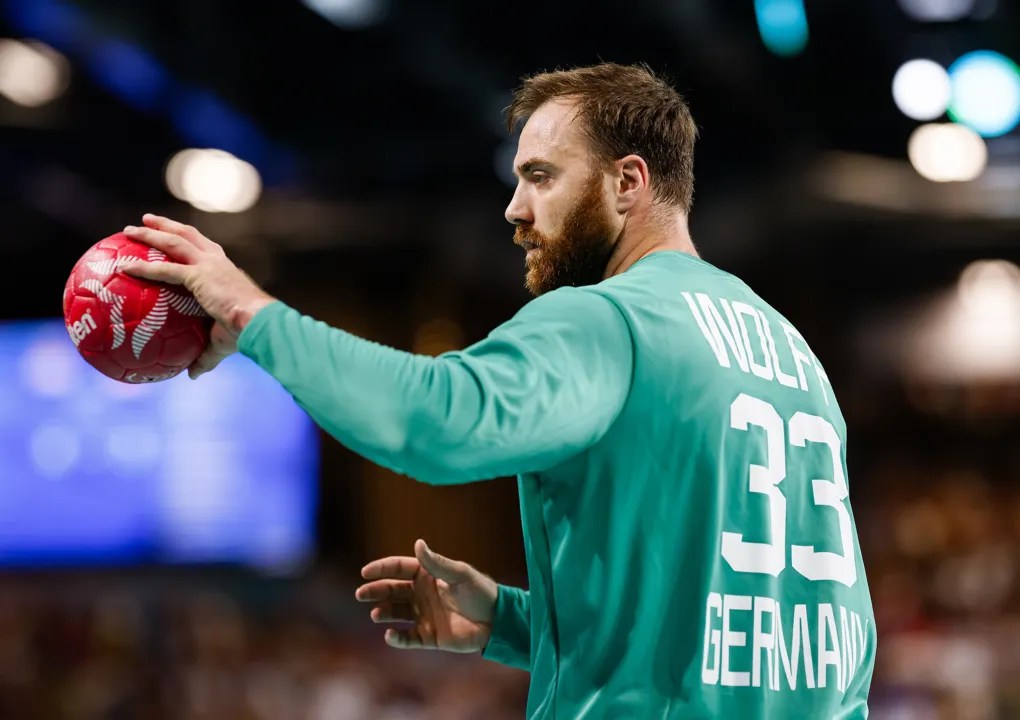
Andreas Wolff, who celebrated his 34th birthday at the beginning of March, became an EHF EURO champion with Germany in 2016, won Olympic silver in 2024 and Olympic bronze in 2016, conquered the EHF Cup with THW Kiel in 2019, then played two EHF Champions League finals with Industria Kielce — and has been back in the goal for THW Kiel since the summer of 2024. In addition, he has also been selected for the All-star Team at numerous tournaments. His impact on the game has been huge. This is his story.
THIS IS ME: ANDREAS WOLFF
My father was a handball player and always took my brother and me to his games — and we always threw the balls around there. Our parents said: ‘if you enjoy it, why don’t you go to training at the local club?’
My brother was still too young and I was five years old when I went to my first handball training session at SG Ollheim/Straßfeld, around 30 kilometres away from Cologne. And my future was already set during my first training session. I was rather reserved and not so communicative, I didn’t want to talk that much with the other boys. Then they told me to go into the goal — and I stayed there.
I changed clubs at the age of 13 — and at HSG Rheinbach I had my first real goalkeeping coach, Dietmar Schwolow, who was absolutely formative for my career. I left home at the age of 16, moved to TV Kirchzell and later played for TV Großwallstadt. When I left home, I had already made up my mind: I was going to be a professional handball player.
The way there was rather funny — I was sitting in front of the computer with a friend when my mate called, saying TV Großwallstadt had called. I pushed him away because I thought it was a joke. When I got home in the evening, my dad also said that Großwallstadt had called. That’s when I realised it — we went to a trial training session and they said I should come, I had potential.
Even as a youth player, I was always in competition mode, whether in training or at matches. At first, I was very nervous before every game, but I had this positive nervousness and tension, I was always full of adrenaline. I already loved these competitive situations back then.
I moved to HSG Wetzlar in 2013 and had my first international match in the same season. In 2016, I was nominated for a major tournament for the first time, the EHF EURO in Poland. After the opening defeat against Spain, we were behind at the break in the second game against Sweden — coach Dagur Sigurdsson told me to go on court. And that was the defining game, I became number one in the German team for the first time.
The game against Sweden was the foundation stone for my later performances in the tournament. We won, I was able to help the team and caught fire.
Of course, everyone talks about our EHF EURO 2016 final against Spain today. I think that was one of my best games ever, along with the 2024 Olympic semi-final, also against Spain.
But I don’t want to really balance until I’ve finished my career. I still want to achieve more, I’m still developing, I still have a lot of plans.
And maybe I’ll watch the EHF EURO 2016 final for the first time when my career is over — I haven’t seen it in full yet. I’ve been shown clips from time to time, my father has watched the game a lot, but I haven’t.
I think that first save against Julen Aguinagalde was the starting signal, and then of course the double save against Alex Dujshebaev and Raul Entrerrios shortly before the final buzzer. In the end, I had 21 saves on my tally, a 48 per cent save rate. 17 goals conceded is still the record for EHF EURO finals. I think this game was the best possible time for such a performance.
But one thing has to be said: Carsten Lichtlein was the ideal goalkeeping partner for me at this tournament, you can’t do it alone. In modern handball, with so many games, you can’t play at the same high level as a goalkeeper for the whole season. The game has become too fast and too dynamic. There are too many crucial situations. Therefore, every team needs two strong goalkeepers to form a real team.
At the moment, I’m lucky to have two outstanding goalkeepers by my side, Tomas Mrkva at the club and David Späth in the national team. We support and complement each other perfectly. You know that if you have a bad day, there’s someone else there, you are not on your own.
Since I started, goalkeeping has not only changed dramatically, but the goalkeeper has become more and more important. In the past, attacks relied extremely on tall backs and the goalkeeper had to cooperate with the defence foremost. THW Kiel, for example, had extremely tall, powerful backline players back then, it was the time of players such as Karol Bielecki, who scored from 10 or 11 metres.
That has changed. There are far fewer of these big players who can shoot from the backcourt. The trend has been towards hybrid players, 1.95 metres tall, who can break through with dynamism, wit and speed, but can also score from a distance. Mathias Gidsel is even shorter and is the perfect example, but Gisli Kristjansson and Felix Claar from SC Magdeburg also stand out for this type of player.
What’s more, today’s backcourt players have an incredible number of shooting variants. It used to be something special when a two-metre man scored with a spin, but today it’s simply part of the repertoire as standard.
The same applies to the wings, who are capable of incredible trick shots. Uwe Gensheimer was a pioneer in this respect, creating a whole series of new variations such as special spins. For goalkeepers, this means that they have to adapt to a wider area of new variations.
Thanks to technical progress, it’s also much easier today to adapt to opponents using video analysis, which used to require a lot more effort in the past.
In the beginning, I wasn’t a fan of video preparation, I preferred to rely on my instincts and intuition. But since I started working with Mattias Andersson in the national team and at THW Kiel, that has changed completely. He’s a master and perfectionist when it comes to video analysis.
In addition to the much larger repertoire of shots from the wing positions and the back, the new, fast-paced style of play has led to many more goals being scored today — mainly thanks to the rule changes concerning the fast throw-off and the many quick breakthroughs. There are fewer and fewer shots from 10 metres, but more and more one-on-one situations for the goalkeepers.
When I started, the games used to end 20:17, and I used to get really annoyed when I conceded 30 goals. Today it’s completely different: in the EHF Champions League we won 40:37 with Kielce against THW Kiel in 2022 — and I ended up with 17 saves, which is actually incredible.
In my opinion, the seven-against-six has only brought a few changes for the goalkeeper, except that we have to run in quickly and therefore have to be more athletic. This style of play is more demanding for the court players.
What generally strikes me, however, is that we have an exceptionally well-trained young generation of goalkeepers.
These top talents such as David Späth, Dominik Kuzmanovic, Matej Mandic, Kristóf Palasics, Diogo Rêma Marques and Constantin Möstl already have very good technique at a young age and present themselves at a very high level early on. This also includes Domenico Ebner, even though he is a little older, but has only now really come into the limelight.
These guys are all much more advanced today than my generation was at that age. That’s definitely down to the highly qualified goalkeeping coaches like Mattias Andersson, who pass on their experience.
What does a goalkeeper need to do to mentally unsettle an opponent and force them to make mistakes? First of all, a physical presence, the space that he closes down — Arpad Sterbik is the best example of this. You simply have to be physically present.
Then, of course, the goalkeeper has to have this reputation that the players know of: if I go up against him, it’s going to be difficult to score, because if he is having a good day, he’ll stop everything.
You have to work for something like that for a long time, like Niklas Landin, for example. Then, the player starts to think about what tricks he can use to get past the goalkeeper — and time is in the goalkeeper’s favour, because he can prepare longer for the shot. Because the player has to act and come up with something, the goalkeeper ‘only’ has to react. And this advantage is really huge.
Of course, you have to have mental strength. A goalkeeper is always the centre of attention, he bears a lot of responsibility for the team’s success. I’m happy to bear this responsibility, I’m happy to help my team.
Source: EHF
 GLITZ SPORTS XPRESS
Leave a comment